
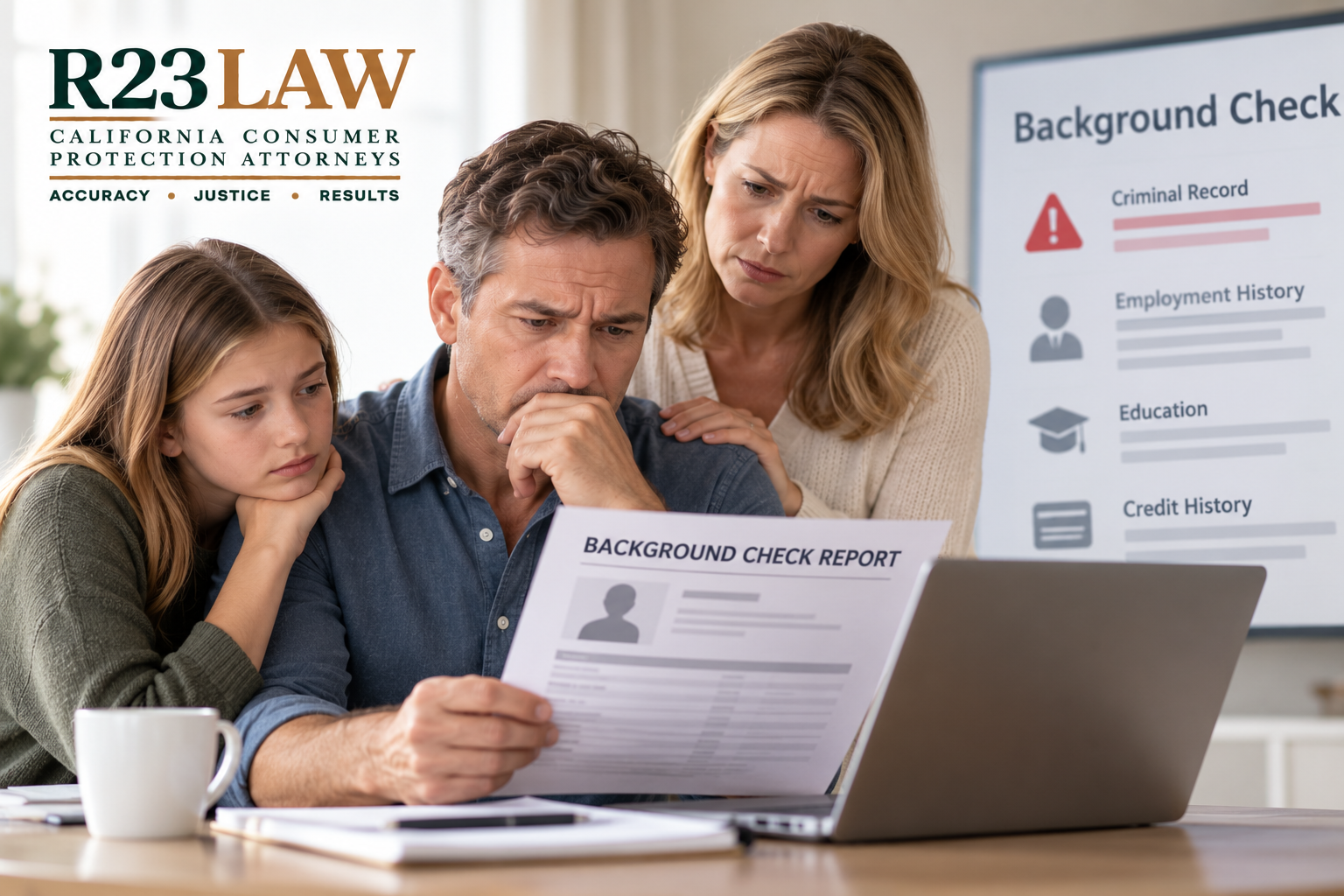
Employers generally must follow federal background check rules before rejecting or firing someone based on a consumer report
Learn about FCRA adverse action rights and when R23 Law’s California Consumer Protection Attorneys may pursue claims involving background check violations.
A background check can have an enormous impact on your livelihood. A mistake involving someone else’s criminal record, outdated information, identity theft, or another reporting error can potentially cost you a job offer, promotion, or even your existing employment.
But when an employer uses a background check to make an employment decision, it generally cannot simply obtain the report, see something it does not like, and immediately take final negative action.
The Fair Credit Reporting Act (FCRA) provides important protections for consumers when employers use qualifying background reports for employment purposes. Those protections can give applicants and employees an opportunity to see the information being used against them and address inaccuracies before an employer makes its final decision.
For California consumers who believe an employer or background screening company failed to follow applicable requirements, R23 Law’s California Consumer Protection Attorneys represent individuals facing the real-world consequences of inaccurate and improperly handled consumer reports.
BACKGROUND CHECKS CAN HAVE REAL EMPLOYMENT CONSEQUENCES
Employers commonly use background checks when making decisions involving applicants and employees. Depending on the circumstances, information contained in a report may influence decisions concerning:
Hiring;
Withdrawal of a conditional job offer;
Promotions;
Continued employment; and
Termination.
That makes accuracy particularly important.
Background reports are not infallible. Errors may include incorrect criminal history, records belonging to another person, outdated information, incomplete records, or misleading reporting. When inaccurate information is used in an employment decision, the consequences can extend far beyond inconvenience.
A lost employment opportunity may affect a consumer’s income, ability to meet financial obligations, housing stability, and career momentum.
BEFORE THE BACKGROUND CHECK – DISCLOSURE AND AUTHORIZATION MATTER
The FCRA establishes requirements that generally apply before an employer obtains a consumer report for employment purposes.
Among other requirements, an employer generally must notify the individual that a background check may be used for employment purposes and obtain the appropriate written authorization.
These protections are significant because consumers should know when information gathered by a consumer reporting agency may become part of an employment decision.
Failures at the beginning of the background-check process can also matter. R23 Law’s California Consumer Protection Attorneys evaluate background screening disputes to determine whether applicable disclosure, authorization, reporting, and adverse-action requirements were followed.
THE PRE-ADVERSE ACTION PROCESS – A CHANCE TO SEE WHAT IS BEING USED AGAINST YOU
One of the most important FCRA protections arises when an employer is considering taking adverse action based, at least in part, on information contained in a consumer report.
Before taking final adverse action, an employer generally must provide the consumer with a copy of the background report and information concerning the consumer’s rights.
This process serves an important purpose: it allows the consumer to review the information being relied upon before the employment decision becomes final.
That opportunity can be crucial when the report contains a serious error.
For example, imagine that a background screening report attributes another person’s criminal record to a job applicant because the two individuals have similar identifying information. Receiving the report before the employer makes its final decision gives the applicant an opportunity to identify and address the problem.
Without that opportunity, an inaccurate report could unfairly derail an employment opportunity before the consumer even knows what went wrong.
ADVERSE ACTION CAN TAKE SEVERAL FORMS
In the employment context, adverse action is not limited to simply refusing to hire someone.
Depending on the circumstances, negative employment action involving a background report may include:
Denying employment;
Withdrawing a job offer;
Denying a promotion; or
Terminating employment.
The procedural protections surrounding these decisions matter because consumers should have a meaningful opportunity to review information being used against them.
TIME TO REVIEW THE REPORT BEFORE A FINAL DECISION
The attached source notes that the FCRA does not establish one universal, exact waiting period applicable to every situation between pre-adverse-action notice and the final employment decision.
The underlying principle, however, is meaningful: the consumer should have an opportunity to review the report and respond before final adverse action is taken.
Many employers provide at least several days between providing the required materials and making the final decision. That period can give the consumer time to identify inaccurate information and begin addressing the problem.
An employer that moves directly from receiving a report to final adverse action may deprive a consumer of the practical opportunity that the pre-adverse-action process is intended to provide.
BACKGROUND CHECK ERRORS CAN FOLLOW THE WRONG PERSON
Background screening errors can arise in numerous ways. Some mistakes may appear minor on paper but have substantial consequences when they affect employment.
Common problems may include:
Mixed Files and Identity Confusion
Information belonging to another person may become associated with a consumer, particularly where individuals have similar names or identifying information.
Incorrect Criminal History
A background report may incorrectly attribute criminal records to an applicant or employee.
Outdated Records
Old information may continue appearing even when it should no longer be reported or when the record no longer accurately reflects the relevant circumstances.
Incomplete or Misleading Information
A report may omit important context or present information in a way that creates a misleading impression.
Identity Theft-Related Information
Fraudulent activity committed using a consumer’s identity can potentially contaminate records and create problems when those records later appear during employment screening.
These errors can be particularly damaging because an employer may initially assume that information appearing in a professional background report is accurate.
R23 LAW’S CALIFORNIA CONSUMER PROTECTION ATTORNEYS ADDRESS BACKGROUND CHECK REPORTING VIOLATIONS
Consumers dealing with background check problems can face two separate challenges: correcting the inaccurate information and addressing the consequences that may already have resulted from its use.
R23 Law’s California Consumer Protection Attorneys represent consumers in disputes involving inaccurate consumer reports and alleged violations of federal and California consumer protection laws.
Depending on the facts, legal representation may involve examining the background report, communications from the employer, notices provided during the hiring process, and the procedures followed by the consumer reporting agency.
R23 Law can also evaluate whether inaccurate information resulted from issues such as mixed files, identity theft, outdated records, or other reporting failures.
CALIFORNIA CONSUMERS MAY HAVE ADDITIONAL BACKGROUND CHECK PROTECTIONS
Federal law is not necessarily the end of the analysis for California consumers.
California has additional laws regulating certain consumer and investigative consumer reports. As reflected throughout R23 Law’s consumer protection practice, California requirements can create protections beyond those available under federal law in appropriate circumstances.
That means a background-check dispute involving a California applicant or employee may require analysis of both the FCRA and applicable California consumer reporting laws.
R23 Law’s California Consumer Protection Attorneys can examine the entire reporting and adverse-action process rather than viewing an inaccurate background check as an isolated clerical problem.
DOCUMENTS CAN MAKE THE DIFFERENCE IN A BACKGROUND CHECK CASE
Consumers who believe a background report affected an employment decision should consider preserving documents connected with the process.
Potentially important records may include:
The background report;
Disclosure and authorization documents;
Pre-adverse-action notices;
Final adverse-action notices;
Emails or letters from the employer;
Communications with the background screening company;
Documents showing that reported information is inaccurate; and
Records concerning the employment opportunity or job offer.
Keeping these materials can make it easier to determine what information was reported, when the employer received it, what notices were provided, and whether the consumer had an opportunity to address an error.
R23 LAW REPRESENTS CONSUMERS HARMED BY INACCURATE BACKGROUND REPORTS
A background check should not become a shortcut around consumer protection law.
When inaccurate information threatens a job opportunity—or when required procedures are not followed—the damage can extend to a consumer’s income, financial security, professional reputation, and future career opportunities.
R23 Law’s California Consumer Protection Attorneys represent consumers facing background check errors, inaccurate consumer reporting, identity theft-related reporting problems, and other potential violations of consumer protection laws.
If a background check contained information that did not belong to you, a job offer was withdrawn because of inaccurate information, or an employer took final negative action without first giving you the report and required information, R23 Law can evaluate the circumstances and the consumer protection laws that may apply.
Contact R23 Law today for a consultation with R23 Law’s California Consumer Protection Attorneys regarding your background check or consumer reporting dispute.
