
CLOSE TO HOME — Domestic Identity Theft in California
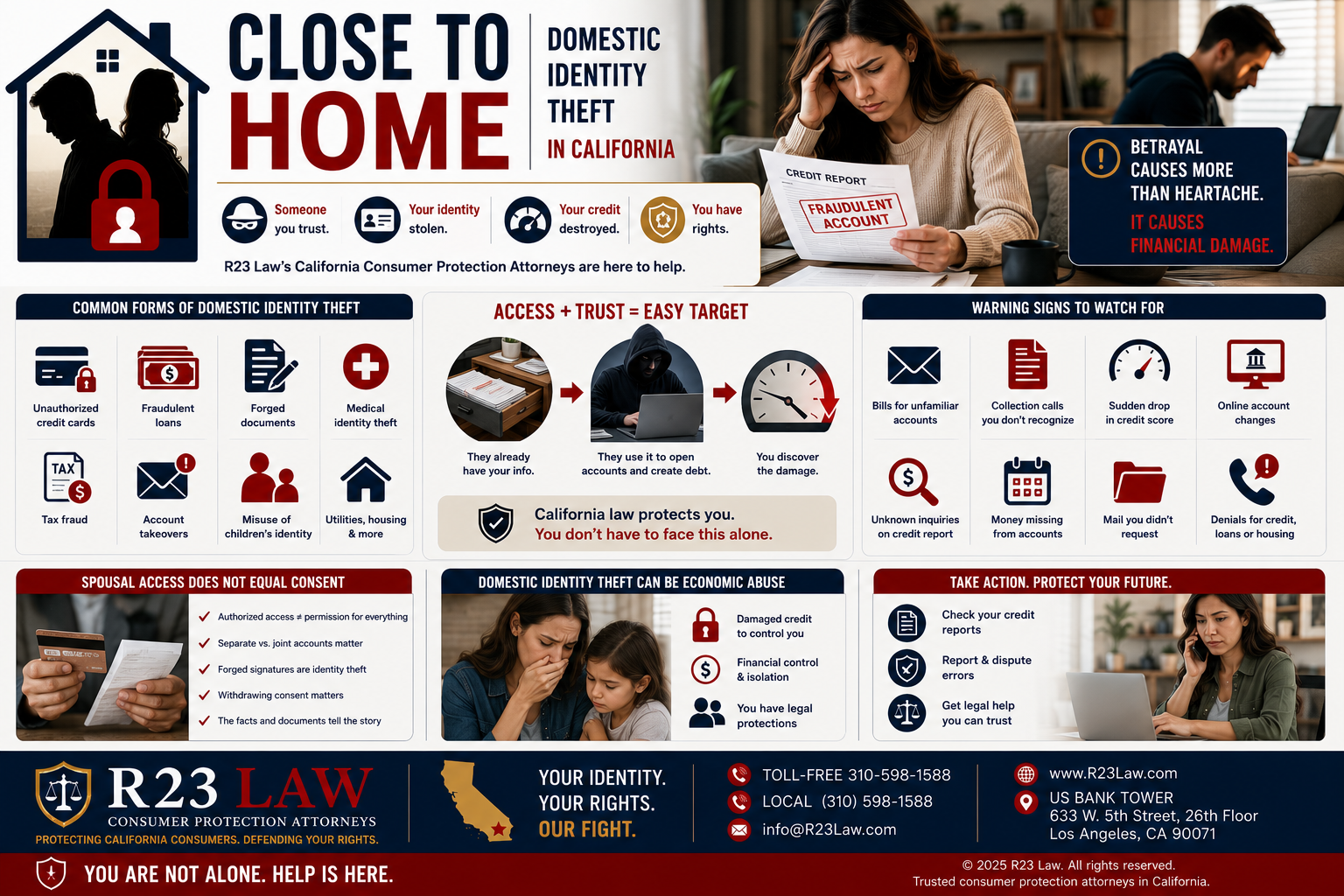
Identity theft is devastating under any circumstances
When the person responsible is a spouse, partner, parent, child, sibling, caregiver, or other trusted relative, the financial damage is compounded by betrayal.
Domestic identity theft occurs when someone with a close personal or family relationship uses another person’s identifying or financial information without permission. The perpetrator may already know the victim’s Social Security number, passwords, banking information, date of birth, and account-recovery answers. That access can make the fraud easier to commit and more difficult to detect.
The victim may discover unauthorized credit cards, personal loans, utility accounts, tax filings, medical charges, or withdrawals from financial accounts. In some cases, the identity theft is part of a broader pattern of economic control designed to damage the victim’s credit and prevent financial independence.
R23 Law's California Consumer Protection Attorneys represent identity theft injury victims throughout California when domestic fraud leads to false accounts, damaged credit, collection activity, and other financial losses.
Domestic Identity Theft Uses Familiarity As Access
California law defines identity theft as the unauthorized use of another person’s identifying information to obtain credit, goods, services, money, or property. Personal identifying information includes names, addresses, Social Security numbers, employment information, bank account numbers, and credit card numbers. A close relationship does not create automatic permission to use that information.
California Penal Code section 530.5 also makes it unlawful to willfully obtain and use another person’s identifying information for an unlawful purpose without consent. The statute can apply when the perpetrator is a stranger, spouse, partner, relative, or another person known to the victim.
Domestic identity theft may remain hidden because the perpetrator has access to the victim’s home, mail, electronic devices, passwords, and financial documents. The fraud may continue for months or years before an unfamiliar account or collection demand exposes it.
Common Forms Of Domestic Identity Theft
Domestic identity theft can take many forms, including—
Using a spouse’s credit card without authorization
Opening credit cards or loans in a partner’s name
Forging a relative’s signature on checks or applications
Using a child’s Social Security number to open utility accounts
Taking over a family member’s email or financial accounts
Filing a fraudulent tax return using a spouse’s information
Applying for student aid under a sibling’s identity
Using a parent’s information to obtain medical services
Applying for housing or a mortgage in a relative’s name
Redirecting another person’s mail
Obtaining government benefits using stolen identifying information
Selling a family member’s personal information
Adding unauthorized users to existing accounts
Changing account addresses or recovery information
Taking out personal loans without the victim’s knowledge
The attached source identifies unauthorized card use, fraudulent loans, forged documents, medical identity theft, tax fraud, account takeovers, and misuse of children’s identities as recurring examples of domestic identity theft.
Spousal Access Does Not Equal Financial Consent
Marriage and shared finances can make domestic identity theft disputes complicated.
A spouse may know account passwords, have access to household documents, or be an authorized user on a credit card. Couples may also maintain joint accounts, separate accounts, or a combination of both.
Not every disputed transaction involving jointly owned money automatically constitutes identity theft. The legal analysis may depend on—
Who owns the account
Whether the alleged perpetrator was an authorized user
The scope of any permission
Whether permission was withdrawn
Whose identity was used to obtain the account
Whether signatures or applications were forged
Whether the victim received any money, property, or benefit
Whether the transaction involved a joint or separate obligation
What the creditor was told during the application process
Opening a new loan in a spouse’s name without permission presents different issues from withdrawing money from an account that both spouses legally own. Account agreements, applications, statements, electronic records, and communications may be essential to determining what occurred.
Domestic Identity Theft Can Become Economic Abuse
Domestic identity theft may be part of a pattern of financial control.
A perpetrator may deliberately damage the victim’s credit so the victim cannot rent an apartment, obtain a vehicle, open a separate bank account, or qualify for financing. The perpetrator may intercept mail, conceal bills, prevent access to money, or create debts that make leaving the relationship financially difficult.
California Courts recognizes that domestic abuse can be emotional, psychological, verbal, physical, or financial. Conduct that prevents someone from accessing money or basic needs may qualify as abuse in appropriate circumstances.
Domestic violence restraining orders may be available against certain spouses, former spouses, intimate partners, and close relatives. Depending on the circumstances, an order may restrict contact, require the restrained person to stay away, protect property, or address financial and family issues.
Domestic identity theft does not automatically establish every requirement for a restraining order. The relationship, conduct, continuing risk, and requested protections must be evaluated individually.
Warning Signs Of Identity Theft By Someone Close
Domestic identity theft may first appear through small or easily overlooked irregularities.
Warning signs include—
Bills arriving for unfamiliar accounts
Mail that repeatedly disappears
Passwords or account addresses changing without permission
New credit inquiries
Unexpected declines in a credit score
Collection calls about unknown debts
Loan or housing denials
Tax notices involving an unfamiliar filing
Medical bills for services never received
Utility accounts at unknown addresses
Account withdrawals the victim did not make
Replacement cards that were never requested
Statements being redirected to another address
A partner refusing to disclose household financial records
Creditors claiming that an application contains the victim’s electronic signature
The Federal Trade Commission identifies unfamiliar bills, withdrawals, new accounts, address changes, and missing statements as common indicators that personal information is being misused.
Immediate Response Steps After Domestic Identity Theft
Prioritize Personal Safety
When identity theft is connected to intimidation, stalking, threats, or domestic violence, financial recovery should be planned with personal safety in mind.
Changing passwords or closing accounts may alert the perpetrator. A victim who fears retaliation may need to use a safe device, private email address, secure mailing address, or trusted contact.
California Courts advises that domestic violence restraining orders may provide temporary protection quickly when the legal requirements are met. Long-term orders can last up to five years.
A person facing immediate danger should contact emergency services.
Secure Email And Financial Accounts
Email access can allow a perpetrator to reset passwords for banking, credit card, loan, and social media accounts.
Victims should consider—
Changing passwords from a secure device
Using a unique password for every account
Activating multifactor authentication
Removing unfamiliar recovery addresses
Reviewing connected devices
Ending unknown account sessions
Changing account security questions
Creating transaction alerts
Replacing compromised cards
Opening a separate account when appropriate
Account changes should be documented before access is removed. Screenshots of unauthorized devices, addresses, and recovery information may become evidence.
Contact Affected Financial Institutions
Notify the fraud department of every bank, creditor, lender, card issuer, utility company, insurer, or payment provider connected to the fraud.
Request that the company—
Restrict or close fraudulent accounts
Stop additional transactions
Preserve account records
Investigate the unauthorized activity
Provide application and transaction documents
Correct internal account information
Stop reporting fraudulent information
Confirm the result in writing
The FTC recommends acting promptly, contacting the companies where fraud occurred, closing or freezing affected accounts, and changing passwords and personal identification numbers.
Preserve The Evidence
Do not discard documents merely because they are upsetting or contain false information.
Preserve—
Credit reports
Account applications
Monthly statements
Collection letters
Text messages
Emails
Voicemails
Forged checks
Loan documents
Tax notices
Medical bills
Utility records
Account login alerts
Address-change notices
Photographs of stolen or opened mail
Fraud claim numbers
Police reports
FTC identity theft reports
Dispute letters
Investigation results
Court papers
A chronological timeline should identify when each account was opened, when the fraud was discovered, when each company was notified, and how each company responded.
Police And FTC Reports Create Important Documentation
Domestic identity theft victims may be reluctant to make a report because the person responsible is a spouse, child, parent, or another family member.
However, creditors and credit reporting agencies may request formal identity theft documentation before removing fraudulent information.
A report through IdentityTheft.gov produces an FTC identity theft report and a personalized recovery plan. The FTC also recommends placing a fraud alert, reviewing credit reports, and identifying accounts or transactions that do not belong to the victim.
A police report may provide additional evidence, especially when the case involves forged documents, stolen mail, unauthorized withdrawals, fraudulent loans, or continuing threats.
Credit Freezes Can Restrict New Fraudulent Accounts
A credit freeze restricts access to a consumer’s credit file and can make it more difficult for another person to open new credit accounts.
Victims generally must contact Equifax, Experian, and TransUnion separately. Freezes are free to place and lift. A freeze does not prevent unauthorized activity on an account that is already open.
A fraud alert provides a different form of protection. An initial fraud alert lasts at least one year and directs prospective creditors to use reasonable identity-verification procedures before opening new credit. A request submitted to one nationwide credit reporting agency must be referred to the other two.
For continuing domestic identity theft, a freeze may provide stronger protection against new-account fraud.
Credit Reports May Reveal The Full Scope Of The Fraud
Victims should examine reports from all three nationwide credit reporting agencies.
Look for—
Loans never requested
Credit cards never opened
Unauthorized inquiries
Unknown addresses
Incorrect telephone numbers
False aliases
Collection accounts
Utility debts
Fraudulent late payments
Accounts connected to another person
Balances created through unauthorized use
A family member may have opened accounts over several years. The first discovered debt may not be the only one.
Identity Theft Information Can Be Blocked From Credit Reports
The Fair Credit Reporting Act provides a special procedure for blocking credit information caused by identity theft.
A consumer generally must provide—
Appropriate proof of identity
A copy of an identity theft report
Identification of the fraudulent information
A statement that the information does not relate to a transaction by the consumer
After receiving the required materials, a credit reporting agency generally must block the identified information within four business days and notify the company that furnished it.
A reporting agency may decline or reverse a block in limited circumstances, including material misrepresentation or evidence that the consumer received goods, services, or money from the transaction.
Domestic relationships often make that last issue particularly important. Dispute documents should clearly explain that the victim did not authorize the transaction and did not receive or use its proceeds.
Victims Can Request Fraudulent Account Records
Identity theft victims may need the original application, address, telephone number, transaction records, signature, or other documents used by the perpetrator.
Federal law gives identity theft victims a process for requesting records from a business connected to the fraud. The FTC states that, after receiving a proper written request and supporting documentation, the business generally must provide the relevant application and transaction records without charge within 30 days.
Those records may reveal—
The address used on the application
The email address or telephone number supplied
The receiving bank account
The delivery location
Electronic device information
A forged signature
The destination of loan proceeds
Contact details connected to the perpetrator
These records may support disputes, litigation, police investigations, and efforts to clear the victim’s name.
California Law Provides Civil Remedies Against Fraudulent Claims
California’s Identity Theft Law allows a person to bring an action against a claimant seeking payment on a transaction created through identity theft.
When identity theft is established, potential relief may include—
A declaration that the victim does not owe the debt
A declaration that a related security interest is void
An injunction stopping collection
Dismissal of a claimant’s lawsuit in appropriate cases
Actual damages
Attorney fees and costs
Equitable relief
A civil penalty of up to $30,000 may also be available when the victim establishes the statutory requirements, including prior written notice, failure to diligently investigate, and continued pursuit of the fraudulent claim.
Written notice and identity theft documentation can be critical. California law requires specific pre-suit notice for certain remedies, so every dispute and delivery record should be preserved.
Fraudulent Debts Can Trigger Wrongful Collection Activity
A creditor may sell or transfer a fraudulent account to a debt collector before the identity theft is resolved.
The victim may then receive—
Collection letters
Repeated calls
Settlement demands
Threatened lawsuits
An actual collection lawsuit
Additional negative credit reporting
A collector’s involvement does not make the debt valid.
Consumers should dispute the debt in writing, include identity theft documentation, request validation, and preserve every communication. Separate protections may apply under the Fair Debt Collection Practices Act, California’s Rosenthal Act, the Fair Credit Reporting Act, and the California Identity Theft Law.
Official court papers require immediate attention. A consumer sued over a domestic identity theft debt should not assume that prior telephone calls or disputes will automatically stop the case.
Child Identity Theft Requires Separate Credit Protection
Parents and relatives sometimes misuse a child’s Social Security number because children usually do not review credit reports.
The fraud may remain hidden until the child applies for—
Student financial aid
A first credit card
An apartment
A vehicle loan
Utility service
Employment requiring financial screening
The FTC recognizes that identity thieves may use a child’s information to obtain credit, services, employment, or benefits. Parents and guardians can take steps to determine whether a child has a credit file and request a freeze when appropriate.
A parent’s legal authority over a child does not create permission to use the child’s identity to obtain fraudulent credit.
R23 Law's Expert Legal Services For Financial Injury Victims Throughout California
R23 Law's California Consumer Protection Attorneys represent domestic identity theft injury victims throughout California in matters involving—
Fraudulent spousal credit accounts
Loans opened by relatives
Forged credit applications
Child identity theft
Unauthorized credit inquiries
Mixed credit files
False late-payment reporting
Identity theft collection accounts
Failed creditor investigations
Failed credit bureau investigations
Bank account takeovers
Unauthorized electronic transactions
Wrongful debt collection
Fair Credit Reporting Act violations
California credit reporting violations
California identity theft claims
R23 Law's California Identity Theft Victim Lawyers review credit reports, account applications, financial statements, dispute correspondence, identity theft reports, collection records, and evidence of financial injury.
The firm focuses on correcting fraudulent financial records, stopping wrongful collection activity, and pursuing available remedies when creditors, collectors, or credit reporting agencies fail to properly respond to documented identity theft.
Betrayal Does Not Transfer The Debt
Domestic identity theft can leave victims believing they must accept the financial damage because the perpetrator is a spouse or relative.
A family relationship does not automatically make a forged loan, unauthorized credit card, or fraudulent account enforceable against the victim. The account records, authorization, use of proceeds, dispute history, and corporate investigation all matter.
R23 Law's California Consumer Protection Attorneys pursue accountability when domestic identity theft is followed by inaccurate credit reporting, inadequate investigations, and collection demands for debts the victim never authorized.
Póngase en contacto con R23 Law hoy mismo.
Domestic identity theft can damage credit, create fraudulent debts, disrupt housing and employment opportunities, and undermine financial independence. R23 Law's California Consumer Protection Attorneys evaluate the account records, dispute history, collection activity, and potential violations of federal and California law.
Toll-Free — 310-598-1588 SoCal — (310) 598-1588 Email — info@R23Law.com Website —www.R23Law.comOffice — US Bank Tower, 633 W. 5th Street, 26th Floor, Los Angeles, CA
© 2025 R23 Law. All rights reserved. Trusted consumer credit lawyers in Los Angeles.
Disclaimer — This article provides general information and does not constitute legal advice. Rights, remedies, deadlines, and available protections depend on the facts of each matter.
